Sell
How to start in Benin’s oil palm value chain?
According to APIEx, Benin imported 159,204 tonnes of refined palm oil in 2023, compared with 2,278 tonnes of crude palm oil; it buys an average of 273 tonnes of palm nuts and kernels a year over 2021-2023.
Unofficial English translation of the French page: the French text prevails. Read the French version.
- Steps
- 8
Who it is for and why
Three products make up the oil palm value chain, each with its Harmonized System (HS) code, the international customs nomenclature: crude palm oil (151110), refined palm oil (151190) and palm nuts and kernels (120710). The Agency for the Promotion of Investments and Exports (APIEx) devotes one study to each, based on trade data for 2021 to 2023 whose sources are dated October 2025.
This guide is for anyone looking for an activity to start in this value chain, whether or not they are already an entrepreneur, as well as for producers and processors already based in Benin: the studies identify the countries that buy the most of each product, those that supply them, and the distances that separate them from Benin.
What you need
- To set up in a special economic zone: be a legal entity, such as a company (see setting up your company online).
- The code of the targeted product: 151110 for crude palm oil, 151190 for refined palm oil, 120710 for palm nuts and kernels.
- For approval under the Investment Code: a project of at least 50,000,000 FCFA excluding tax, filed with APIEx (see the approval page).
- To sell abroad: a certificate of origin (certificat d’origine) issued by the External Trade Directorate (Direction du Commerce Extérieur) (see the guide on importing and exporting).
- Official fees, separate from any other cost. Company, on monentreprise.bj: 22,000 FCFA for an SARL or SUARL, 37,000 FCFA for an SA, SAS, SNC or SCS. Approval under the Investment Code: 200,000 FCFA under regime A, 400,000 FCFA under regime B and 600,000 FCFA under regime C, according to APIEx. Certificate of origin: 0 FCFA according to the public services portal page, with the application made on a form bearing a 500 FCFA tax stamp.
The steps
Choose between crude palm oil, refined palm oil and palm nuts
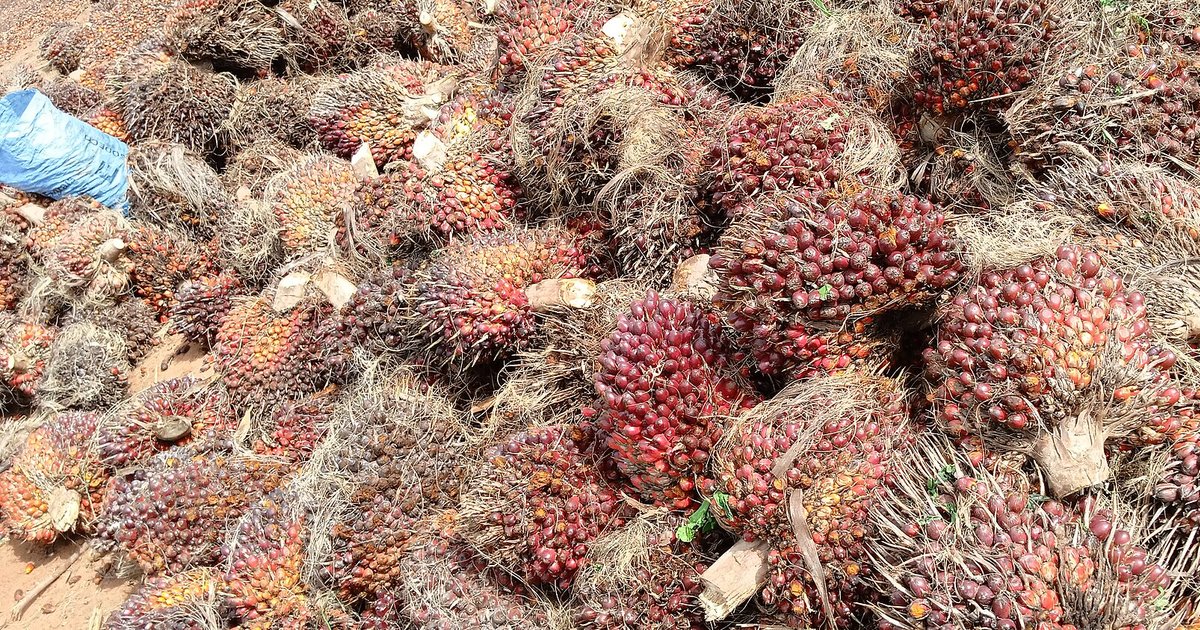
Crude palm oil is extracted from fresh fruit bunches, and its yield per tonne of bunches depends on the variety: 20 to 25% for tenera (originating in Malaysia and Indonesia), 18 to 23% for Latin American hybrids and 15 to 20% for dura, a West African variety. According to the study on crude palm oil, it is used for human food, the food industry, cosmetics and personal care.
Refining produces refined palm oil. For the move from crude to refined oil, the study on refined oil gives a yield rate of 88 to 92% for Malaysian and Indonesian tenera, 85 to 90% for African tenera, 86 to 91% for Latin American hybrids and 82 to 87% for dura. It cites four by-products: stearin, olein, free fatty acids and gums.
Palm nuts and kernels form a separate product, covered in the study on palm nuts and kernels: they yield palm kernel oil, palm kernel cake and shells.
- Where: https://investbenin.bj/assets/upload/others/654d2046-cfc9-4de0-987e-6a1ebc0752d9.pdf
Size up the raw material
In its section on the Beninese market, the study on palm nuts and kernels gives an annual production of oil palm nuts of 671,036 tonnes in 2020, 749,193 in 2021, 855,456 in 2022 and 908,394 in 2023.
The studies on crude palm oil and on refined palm oil each cite two investment projects: an integrated production unit (for crude palm oil, or for refined palm oil) and oil palm cultivation.
- Where: https://investbenin.bj/assets/upload/others/1e5f3525-17cf-4824-9c21-e3b7c2beff92.pdf
Measure what Benin imports
Crude palm oil: 1,257 tonnes in 2020, 14,365 in 2021, 6,407 in 2022 and 2,278 in 2023; the study uses an annual average of 7,683 tonnes over 2021-2023. It attributes the 2021 rise to the start-up of a company that processes crude palm oil into refined palm oil. On average over these three years, Togo supplies 2,258 tonnes a year, Malaysia 1,849, Indonesia 1,667, Ghana 957 and Côte d’Ivoire 835.
Refined palm oil: 83,947 tonnes in 2020, 77,488 in 2021, 76,340 in 2022 and 159,204 in 2023; the annual average used over 2021-2023 is 104,344 tonnes. Malaysia supplies 53,642 tonnes a year, Indonesia 38,352, Singapore 5,197, Togo 2,014 and the United Arab Emirates 1,915; Italy, Spain, Lebanon and Sierra Leone complete the list.
Palm nuts and kernels: 273 tonnes a year on average over 2021-2023, of which 271 come from Togo, 1.7 from Nigeria and 0.7 from China.
- Where: https://investbenin.bj/assets/upload/others/583e6f2a-a1af-499e-bedf-eb01c5e404ef.pdf
Choose the site and the regime
The three studies cite the same sites: the GDIZ (Glo-Djigbé Industrial Zone), in the Atlantique department, and Sèmè Kpodji, in the Ouémé department, two special economic zones, as well as Gakpé, an industrial zone in Atlantique.
The regime matters for sales: according to the studies, industries in special economic zones approved under the intra-community regime are not authorised to export outside the Economic Community of West African States (ECOWAS). The page on the special economic zones regime describes the two regimes, the export regime and the intra-community trade regime; the page on approval under the Investment Code describes how the application is filed with APIEx.
- Where: https://entreprendre.bj/en/dispositifs/regime-zones-economiques-speciales-benin/
Target ECOWAS markets first
The following figures are average annual imports over 2021-2023 in “ECOWAS before 2025”. For crude palm oil, Senegal imports 50,113 tonnes a year, Côte d’Ivoire 31,184, Ghana 24,932, Nigeria 16,558 and Togo 9,688; Benin comes next, with 7,683 tonnes. In Nigeria, India is the leading supplier cited, at 15,904 tonnes a year.
For refined palm oil, Togo (274,915 tonnes), Ghana (190,059) and Niger (160,483) are ahead of Benin (104,344), followed by Senegal (89,163), Burkina Faso (73,495), Guinea (69,960) and Mali (62,526). For palm nuts and kernels, Côte d’Ivoire imports 10,897 tonnes a year and Ghana 4,093, Benin 273. The study on refined oil also cites Benin among Togo’s suppliers, at 296 tonnes a year.
The studies note a customs duty exemption on products originating in the sub-region. Togo, Senegal, Côte d’Ivoire, Burkina Faso, Niger and Mali use, like Benin, the CFA franc of the Central Bank of West African States (BCEAO); Nigeria, Ghana and Guinea have their own currency.
- Where: https://investbenin.bj/assets/upload/others/654d2046-cfc9-4de0-987e-6a1ebc0752d9.pdf
Look at distant markets and competitors
For crude palm oil, the world’s leading importers are India (6,974,899 tonnes a year), the Netherlands (1,373,404) and Kenya (753,927), which is also Africa’s leading buyer. For refined palm oil, they are China (5,651,532), Pakistan (2,832,698), India (1,922,626), the United States (1,728,588) and Bangladesh (1,533,024); in Africa, Egypt (911,269), Ethiopia (638,918) and South Africa (497,807). For palm nuts and kernels, Malaysia (42,567), Costa Rica (41,169) and Thailand (13,813) lead.
For oil, the competing suppliers are Asian: to the world’s ten leading importers, Malaysia exports 4,229,641 tonnes a year and Indonesia 3,561,315 for crude palm oil, and Indonesia 14,008,675 and Malaysia 3,666,111 for refined palm oil. For palm nuts and kernels, the study cites Panama (28,189 tonnes), Thailand (21,348) and Myanmar (13,798).
- Where: https://investbenin.bj/assets/upload/others/583e6f2a-a1af-499e-bedf-eb01c5e404ef.pdf
Organise transport and export documents
Each study lists twelve shipping lines and eighteen airlines operating in Cotonou, with their contact details. For Benin, they list the port and airport of Cotonou, as well as the borders with Nigeria, Togo, Niger and Burkina Faso.
To sell abroad, the certificate of origin (certificat d’origine) attests that the product originates in Benin: the guide on foreign trade documents states where to request it.
- Where: https://entreprendre.bj/en/guides/vendre/importer-exporter-benin-attestation-certificat-origine/
Put the financing together
The National Agricultural Development Fund (Fonds national de développement agricole, FNDA) supports those who produce, process or market agricultural products. Its guarantee, interest subsidy and grants are detailed in the guide on agricultural financing.
- Where: https://entreprendre.bj/en/guides/financer/fnda-financement-agricole-benin/
The pitfalls
- Confusing the three products. Each has its own code (151110, 151190, 120710), its own study and its own buyers: the 159,204 tonnes of refined oil imported in 2023 do not measure the crude palm oil market.
- Comparing a single year with an average. Markets are quantified as annual averages over 2021-2023; Benin’s imports are given year by year, from 2020 to 2023, then as an average.
- Reading “ECOWAS” as today’s ECOWAS. The studies cover “ECOWAS before 2025”, which includes Mali, Burkina Faso and Niger.
- Counting on exports outside ECOWAS from a zone under the intra-community regime, which does not allow them.
Frequently asked questions
Which product does Benin import the most?
Refined palm oil: 104,344 tonnes a year on average over 2021-2023, compared with 7,683 tonnes for crude palm oil and 273 tonnes for palm nuts and kernels, according to the APIEx studies.
What yield can be expected from a tonne of palm fruit bunches?
According to the study on crude palm oil, 20 to 25% for tenera, 18 to 23% for hybrids and 15 to 20% for dura, per tonne of fresh bunches.
Can a company export from a special economic zone?
Industries in special economic zones approved under the intra-community regime are not authorised to export outside ECOWAS, according to the three studies. The page on the special economic zones regime details the two regimes.
What are the by-products of the oil palm used for?
Mesocarp fibres are used as fuel; treated sludge and effluents produce biogas or, after settling, an organic fertiliser. Palm kernel cake feeds livestock, and shells provide biofuel and activated carbon. In refining, stearin goes to industrial margarines and hard soaps, olein to frying oil, free fatty acids to soap-making and biodiesel, and gums to food emulsifiers and animal feed.
What distances separate Benin from the main markets?
By land, the studies count 119 km to Nigeria, 156 km to Togo, 867 km to Côte d’Ivoire, 1,038 km to Burkina Faso and 2,886 km to Senegal. By sea, they count 62 nautical miles to Nigeria, 70 to Togo, 261 to Ghana, 398 to Côte d’Ivoire, 4,140 to the Netherlands, 8,053 to India and 10,263 to China (one nautical mile equals 1.852 km).
Related incentive schemes
 APIEx
Approval under Benin's Investment Code
Companies governed by Beninese law, national or foreign, that invest at least 50,000,000 FCFA excluding tax, and promoters of tourism, cultural, sports, health, education or warehousing infrastructure projects.
dispositifpermanent FNDA
National Agricultural Development Fund
Farmers, agricultural entrepreneurs and agricultural businesses, and farmers’ professional organisations (OPA), that produce, process or market agricultural, animal or fisheries products.
financingpermanent APIEx
Special economic zones (SEZ) regime
Companies, Beninese or foreign, incorporated as legal entities, that want to set up a production, processing or assembly unit, or infrastructure for industry or trade, in a special economic zone.
dispositifpermanent