Manage
How to file and pay the TPS in Benin?
The synthetic professional tax (TPS) is paid in two instalments, from 1 to 10 February and from 1 to 10 June, plus a balance paid with the return by 30 April at the latest, according to the General Tax Code.
Unofficial English translation of the French page: the French text prevails. Read the French version.
- Steps
- 6
- Observed lead time
- Code deadlines: 1 to 10 February (instalment), 30 April (return and balance), 1 to 10 June (instalment) (articles 184 and 185).
- Year of the rates used
- 2025
Who it is for and why
The synthetic professional tax (taxe professionnelle synthétique, TPS) is the single tax that replaces business profits tax, the business licence contribution (contribution des patentes), the licence contribution (contribution des licences) and the employer payroll contribution (General Tax Code (Code général des impôts), article 178).
The TPS applies to businesses subject to business profits tax whose turnover does not exceed a ceiling set by ministerial order; those subject to corporate income tax, by right or by option, are excluded (articles 178 and 179).
What you need
- An IFU (unique tax identifier). The return must include the unique tax identifier number (article 184).
- Two registers: for TPS businesses, the code requires a purchases and expenses register or notebook and a sales and services register or notebook, each filled in chronologically (article 480). Accounting documents are kept in Benin for ten years.
- Standardised invoices for transactions, unless the Director General of Taxes grants an exemption (article 481). They are issued and transmitted by an electronic invoicing machine certified by the General Directorate of Taxes (article 482).
- The financial statements, to be attached to the return, and the return in three copies (article 184).
- The figures for the past year: annual receipts and turnover per establishment, purchases for the year broken down by type of goods, annual business rent, five main suppliers and five main customers.
- Amounts set by the code, separate from any other cost (2026 edition, article 183):
| Item | Amount |
|---|---|
| Rate on annual receipts | 5% |
| Minimum tax | 10,000 FCFA |
| Additional fee, payable to the national radio and television broadcasting company | 4,000 FCFA |
By calculation from these two figures, the minimum applies when 5% of receipts falls below 10,000 FCFA, that is, for annual receipts below 200,000 FCFA. The tax is due per establishment and per commune.
The steps
Identify your deadlines
Newly created businesses that are duly formed are exempt from the TPS for their first twelve months of activity. The TPS starts to run on the first day of the month following the end of those twelve months, and the business then pays the minimum of 10,000 FCFA during the first ten days of that month (articles 180 and 185). Artists who sell only their own works and farming, fishing and livestock businesses are also exempt (article 180).
For everyone else, the year unfolds in three stages. Two provisional instalments, calculated on the basis of the previous year’s tax, are paid spontaneously in the first ten days of February and June (article 185); a delay in paying an instalment incurs a penalty of 10% of the amount whose payment is deferred (article 487). The return and the balance are due by 30 April at the latest, as detailed below.
- Where: Competent local tax office (service des impôts territorialement compétent)
- Observed time: instalments from 1 to 10 February and from 1 to 10 June (article 185); return and balance by 30 April at the latest (article 184)
Know where and how to file and pay
The return is filed with the competent local tax office (article 184). For payment, article 600 lists cash payments at the tax collector’s counter, certified bank or postal cheque, bank or postal transfer to an account of the General Directorate of Taxes, and other means authorised by the administration. It also allows electronic methods “under the conditions determined by regulation”.
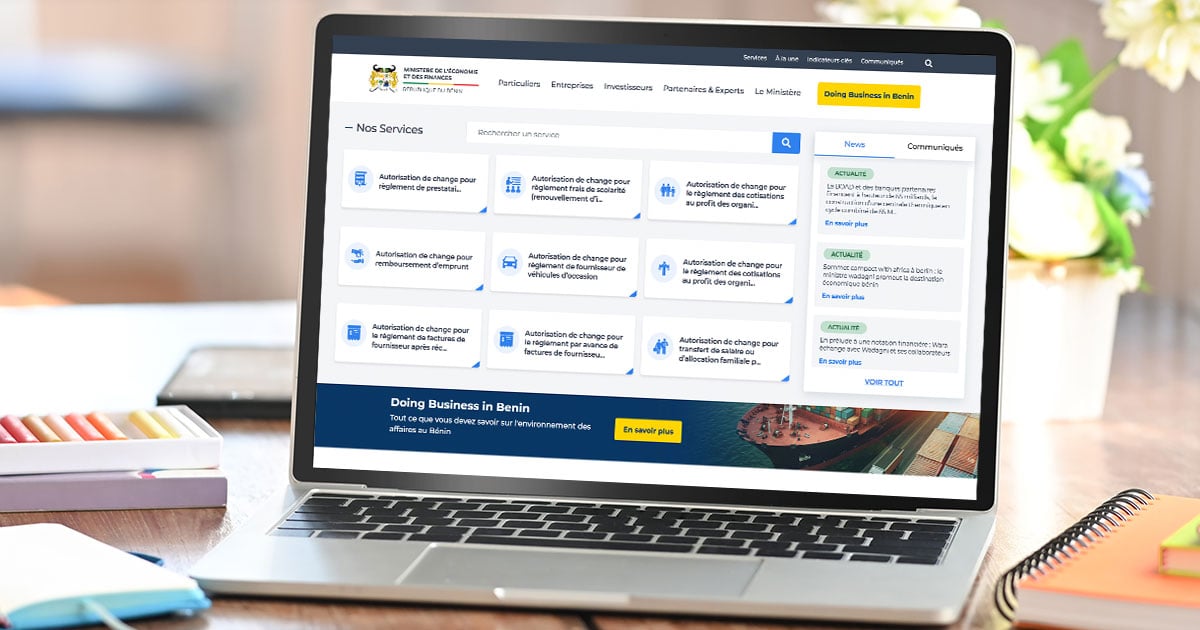
Each TPS payment is evidenced by a payment receipt (quittance) (articles 186 and 601), which may be issued electronically. The Ministry of the Economy and Finance website presents eservices.impots.bj as the platform for filing and paying a business’s taxes and duties.
- Where: https://finances.bj/services/eservices/
File the return and pay the balance by 30 April at the latest
The return covers the previous financial year. Besides the financial statements, it states: surname and first names or company name; the IFU; the nature of the activities; the location (city, district, block, plot, street, entrance, door number); the post office box; the telephone number and, if there is one, the e-mail address; the list of the five main suppliers and five main customers; the amount of the previous year’s purchases by type of goods; annual receipts and turnover per establishment; the annual amount of business rent (article 184).
The tax is calculated as follows: 5% of annual receipts, with a minimum of 10,000 FCFA, to which the 4,000 FCFA fee is added (article 183). Instalments already paid and any withholdings on account of profit-based tax are credited against the return; if it shows a credit, it is set against the following instalments (article 185).
The return, in three copies, is filed with the competent local tax office. Any balance is paid by 30 April at the latest, when the return is filed (articles 184 and 185).
- Where: Competent local tax office (service des impôts territorialement compétent)
- Observed time: deadline set by article 184: 30 April each year, for the previous financial year
If payment or filing is late
The 2026 edition of the code provides for: a late-filing penalty of 20% of the tax for a return filed out of time, raised to 40% if it is not filed within thirty days of a formal notice (article 485); a penalty of 10% on the unpaid portion of a tax payable spontaneously (article 487); and late-payment interest of 0.25% per month or part of a month, running from the first day of the month following the due date and not exceeding the amount of the basic tax (article 488). The penalty under article 485 “is deemed to include late-payment interest”, whereas the interest under article 488 applies “independently of the penalties provided for by the preceding articles”.
For 2026, the finance law adds a specific provision. Between 1 January and 31 December 2026, tax penalties, fines and surcharges do not apply to taxpayers who spontaneously file, for the first time, their returns for previous financial years and pay the full amount due. The benefit is conditional on there being no tax audit or tax investigation under way (Law no. 2025-22, article 3).
- Where: Competent local tax office (service des impôts territorialement compétent)
If your situation changes: option, exceeding the threshold, selling in markets
Voluntarily switching to business profits tax. The express request can be filed at any time with the tax office, which replies within eight days, by approval or refusal; no reply means acceptance. The option applies from the first day of the month following acceptance and can no longer be withdrawn (article 181).
Exceeding the threshold. The business moves to business profits tax no later than the first day of the month following the one in which the excess is noted; if it occurs in December, the change takes place only the following year. Purchases of goods, services and equipment, and contracts signed, also count in assessing the threshold. The TPS already paid serves as an instalment, split equally between local taxes and State taxes (article 182).
Itinerant traders (street vendors, market sellers, stalls not fixed to the ground). They pay all their dues in advance, in a single payment, before 1 March each year. Their rate, set by regulation, may not exceed 5%, the rate in article 183. The payment receipt is given only against full payment, and proof of taxation must be shown at the request of officials (articles 188 and 189). Without proof of payment, goods may be seized or the vehicle immobilised (article 490).
- Where: Competent local tax office (service des impôts territorialement compétent)
Two reliefs provided by the code
For a business that is absent from the General Directorate of Taxes’ taxpayer register and whose turnover excluding tax does not exceed 50,000,000 FCFA, joining an approved management centre (centre de gestion agréé) entitles it to a 40% reduction of the TPS for the first four years of membership. Voluntarily leaving the centre during the two financial years following membership cancels the reduction and leads to an adjustment of the tax; the reduction cannot be combined with another preferential or special regime (article 148).
In addition, persons who have set up an electronic invoicing system and acquired certified electronic invoicing machines may ask the Director General of Taxes for a flat-rate reimbursement of the acquisition costs. For TPS businesses, it is full at the end of the first year of actual use and takes the form of a credit that can be set against the tax (article 483).
- Where: General Directorate of Taxes
The pitfalls
- Believing the return is the only deadline. There are three: an instalment from 1 to 10 February, the return and balance by 30 April at the latest, an instalment from 1 to 10 June.
- Forgetting an establishment or the fee. Each establishment, in each commune, has its own tax, and the 4,000 FCFA fee is charged in addition (article 183).
- Relying on an old edition of the code. Article 183 of the 2023 edition provided for, in addition to the 4,000 FCFA fee (then paid to the Benin radio and television broadcasting office), a levy of 2,000 to 50,000 FCFA for the benefit of local authority budgets, for household waste collection. Article 183 of the 2026 edition, marked “amended by the 2024 finance law” (“modifié par la loi de finances pour 2024”), no longer contains this levy; the 4,000 FCFA fee is paid there to the national radio and television broadcasting company. The household waste collection tax is dealt with separately, in articles 221 and 222: occupants of buildings and properties subject to the single property tax, or exempt from it under article 153, are liable for it, and its rate is set by a regulatory text. Except for article 183, articles 148 and 178 to 190 are worded identically in both editions.
- Neglecting the IFU and the sign. The absence of an IFU where one is required, or of a business sign showing the IFU (article 463), is punished by a tax fine of 100,000 FCFA (article 495).
Frequently asked questions
How much is the TPS?
The code sets 5% of annual receipts, with a floor of 10,000 FCFA, and adds a fee of 4,000 FCFA (General Tax Code, 2026 edition, article 183). The rate for itinerant traders is set by regulation and may not exceed that of article 183 (article 188).
Which dates should you remember for the TPS?
First instalment from 1 to 10 February, return and balance by 30 April at the latest, second instalment from 1 to 10 June (articles 184 and 185). Itinerant traders must have paid everything before 1 March (article 189).
What is the turnover threshold for falling under the TPS?
The threshold is set by an order of the minister in charge of finance (article 178). The figure of 50,000,000 FCFA in article 148 concerns another measure, the reduction for joining an approved management centre.
Can you file and pay the TPS online?
The code provides for a return filed with the competent local tax office (article 184) and allows electronic payment methods under the conditions set by regulation (article 600). The ministry presents eservices.impots.bj as the platform for filing and paying a business’s taxes.
What are the risks if you are late?
A 20% penalty on the tax for a late return, 10% for an instalment or balance paid late, and interest of 0.25% per month (articles 485, 487 and 488). In 2026, spontaneous regularisation of a first return for previous financial years is exempt from penalties, fines and surcharges (Law no. 2025-22, article 3).